“GIVE and GAIN – LIFE IS AN ECHO, WHAT YOU SEND OUT COMES BACK” “WOULD YOU CONSIDER A SMALL GIFL OF $11,11 OR MORE TO HELP OUR WORKS” PAYPAL Donate: https://goo.gl/nDzY2G Donations To Help Others In Need: https://goo.gl/uwkt1Z
Spread love and Kindness, Like, Subscribe to Get Daily Updates Show your support & Love for Awakening YOU channel. Thank you so much
Ludvig Lundin sends this report of a spectacular Sun halo display, with a 22° halo, parhelic circle, sundogs and a tangent arc as well as 44° parhelia (sundogs) and 46° halo, in Vemdalen, Sweden today, Dec 1 – thank you. Video by @vemdalen
For the past 13 years, highly-attuned empathic healer and best-selling author, Matt Kahn, has been astounding audiences by revolutionizing all aspects of the spiritual journey through his profoundly healing teachings. Focusing his message on offering the most loving approach to each stage of exploration, Matt has carved a brand-new path for those yearning for true liberation, emotional freedom, and to embody their soul’s full potential.
Lory is a QHHT Practitioner and can be reached by his website, which is also a hub of information about the new earth: http://soulselfawareness.com/blog/
Visit the Higher Self Portal website and mingle with like-minded Co-Creators, build a profile, blog, chat, read articles, watch videos, and more! https://higherselfportal.com/
Every day in June, the most popular wedding month of the year, about 13,000 American couples will say “I do,” committing to a lifelong relationship that will be full of friendship, joy, and love that will carry them forward to their final days on this earth.
Except, of course, it doesn’t work out that way for most people. The majority of marriages fail, either ending in divorce and separation or devolving into bitterness and dysfunction. Of all the people who get married, only three in ten remain in healthy, happy marriages, as psychologist Ty Tashiro points out in his book The Science of Happily Ever After, which was published earlier this year.
Social scientists first started studying marriages by observing them in action in the 1970s in response to a crisis: Married couples were divorcing at unprecedented rates. Worried about the impact these divorces would have on the children of the broken marriages, psychologists decided to cast their scientific net on couples, bringing them into the lab to observe them and determine what the ingredients of a healthy, lasting relationship were. Was each unhappy family unhappy in its own way, as Tolstoy claimed, or did the miserable marriages all share something toxic in common?
Psychologist John Gottman was one of those researchers. For the past four decades, he has studied thousands of couples in a quest to figure out what makes relationships work. I recently had the chance to interview Gottman and his wife Julie, also a psychologist, in New York City. Together, the renowned experts on marital stability run The Gottman Institute, which is devoted to helping couples build and maintain loving, healthy relationships based on scientific studies.
John Gottman began gathering his most critical findings in 1986, when he set up “The Love Lab” with his colleague Robert Levenson at the University of Washington. Gottman and Levenson brought newlyweds into the lab and watched them interact with each other. With a team of researchers, they hooked the couples up to electrodes and asked the couples to speak about their relationship, like how they met, a major conflict they were facing together, and a positive memory they had. As they spoke, the electrodes measured the subjects’ blood flow, heart rates, and how much they sweat they produced. Then the researchers sent the couples home and followed up with them six years later to see if they were still together.
From the data they gathered, Gottman separated the couples into two major groups: the masters and the disasters. The masters were still happily together after six years. The disasters had either broken up or were chronically unhappy in their marriages. When the researchers analyzed the data they gathered on the couples, they saw clear differences between the masters and disasters. The disasters looked calm during the interviews, but their physiology, measured by the electrodes, told a different story. Their heart rates were quick, their sweat glands were active, and their blood flow was fast. Following thousands of couples longitudinally, Gottman found that the more physiologically active the couples were in the lab, the quicker their relationships deteriorated over time.
But what does physiology have to do with anything? The problem was that the disasters showed all the signs of arousal—of being in fight-or-flight mode—in their relationships. Having a conversation sitting next to their spouse was, to their bodies, like facing off with a saber-toothed tiger. Even when they were talking about pleasant or mundane facets of their relationships, they were prepared to attack and be attacked. This sent their heart rates soaring and made them more aggressive toward each other. For example, each member of a couple could be talking about how their days had gone, and a highly aroused husband might say to his wife, “Why don’t you start talking about your day. It won’t take you very long.”
The masters, by contrast, showed low physiological arousal. They felt calm and connected together, which translated into warm and affectionate behavior, even when they fought. It’s not that the masters had, by default, a better physiological make-up than the disasters; it’s that masters had created a climate of trust and intimacy that made both of them more emotionally and thus physically comfortable.
Gottman wanted to know more about how the masters created that culture of love and intimacy, and how the disasters squashed it. In a follow-up study in 1990, he designed a lab on the University of Washington campus to look like a beautiful bed and breakfast retreat. He invited 130 newlywed couples to spend the day at this retreat and watched them as they did what couples normally do on vacation: cook, clean, listen to music, eat, chat, and hang out. And Gottman made a critical discovery in this study—one that gets at the heart of why some relationships thrive while others languish.
Throughout the day, partners would make requests for connection, what Gottman calls “bids.” For example, say that the husband is a bird enthusiast and notices a goldfinch fly across the yard. He might say to his wife, “Look at that beautiful bird outside!” He’s not just commenting on the bird here: he’s requesting a response from his wife—a sign of interest or support—hoping they’ll connect, however momentarily, over the bird.
The wife now has a choice. She can respond by either “turning toward” or “turning away” from her husband, as Gottman puts it. Though the bird-bid might seem minor and silly, it can actually reveal a lot about the health of the relationship. The husband thought the bird was important enough to bring it up in conversation and the question is whether his wife recognizes and respects that.
People who turned toward their partners in the study responded by engaging the bidder, showing interest and support in the bid. Those who didn’t—those who turned away—would not respond or respond minimally and continue doing whatever they were doing, like watching TV or reading the paper. Sometimes they would respond with overt hostility, saying something like, “Stop interrupting me, I’m reading.”
These bidding interactions had profound effects on marital well-being. Couples who had divorced after a six-year follow up had “turn-toward bids” 33 percent of the time. Only three in ten of their bids for emotional connection were met with intimacy. The couples who were still together after six years had “turn-toward bids” 87 percent of the time. Nine times out of ten, they were meeting their partner’s emotional needs.
* * *
By observing these types of interactions, Gottman can predict with up to 94 percent certainty whether couples—straight or gay, rich or poor, childless or not—will be broken up, together and unhappy, or together and happy several years later. Much of it comes down to the spirit couples bring to the relationship. Do they bring kindness and generosity; or contempt, criticism, and hostility?
“There’s a habit of mind that the masters have,” Gottman explained in an interview, “which is this: they are scanning social environment for things they can appreciate and say thank you for. They are building this culture of respect and appreciation very purposefully. Disasters are scanning the social environment for partners’ mistakes.”
“It’s not just scanning environment,” chimed in Julie Gottman. “It’s scanning the partner for what the partner is doing right or scanning him for what he’s doing wrong and criticizing versus respecting him and expressing appreciation.”
Contempt, they have found, is the number one factor that tears couples apart. People who are focused on criticizing their partners miss a whopping 50 percent of positive things their partners are doing and they see negativity when it’s not there. People who give their partner the cold shoulder—deliberately ignoring the partner or responding minimally—damage the relationship by making their partner feel worthless and invisible, as if they’re not there, not valued. And people who treat their partners with contempt and criticize them not only kill the love in the relationship, but they also kill their partner’s ability to fight off viruses and cancers. Being mean is the death knell of relationships.
Kindness, on the other hand, glues couples together. Research independent from theirs has shown that kindness (along with emotional stability) is the most important predictor of satisfaction and stability in a marriage. Kindness makes each partner feel cared for, understood, and validated—feel loved. “My bounty is as boundless as the sea,” says Shakespeare’s Juliet. “My love as deep; the more I give to thee, / The more I have, for both are infinite.” That’s how kindness works too: there’s a great deal of evidence showing the more someone receives or witnesses kindness, the more they will be kind themselves, which leads to upward spirals of love and generosity in a relationship.
There are two ways to think about kindness. You can think about it as a fixed trait: either you have it or you don’t. Or you could think of kindness as a muscle. In some people, that muscle is naturally stronger than in others, but it can grow stronger in everyone with exercise. Masters tend to think about kindness as a muscle. They know that they have to exercise it to keep it in shape. They know, in other words, that a good relationship requires sustained hard work.
“If your partner expresses a need,” explained Julie Gottman, “and you are tired, stressed, or distracted, then the generous spirit comes in when a partner makes a bid, and you still turn toward your partner.”
In that moment, the easy response may be to turn away from your partner and focus on your iPad or your book or the television, to mumble “Uh huh” and move on with your life, but neglecting small moments of emotional connection will slowly wear away at your relationship. Neglect creates distance between partners and breeds resentment in the one who is being ignored.
The hardest time to practice kindness is, of course, during a fight—but this is also the most important time to be kind. Letting contempt and aggression spiral out of control during a conflict can inflict irrevocable damage on a relationship.
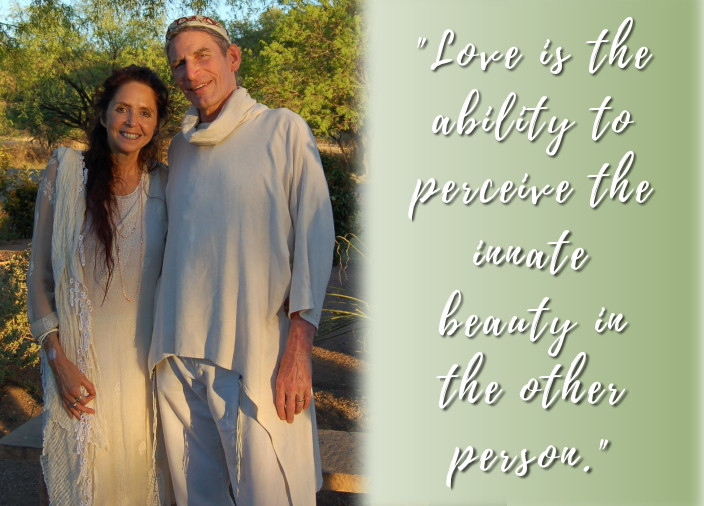
Love is the ability to perceive the innate beauty in the other person. Love gives you the perception to see the wild authenticity of the true nature of the other person. Love is not blind. Love is the microscope that allows you to fully see and appreciate the other person in their deepest truth.
The key to sacred relationship is to have the spiritual perception of who you are and who the other is. This essential spiritual understanding is the foundation of sacred relationship.
Sacred relationship is the oldest and the newest frontier. In today’s society, the whole meaning of relationship as sacred – as an evolutionary way of life – is not exactly a focus. But it’s the newest frontier and represents the cutting edge of consciousness.
Sacred relationship is a high risk situation. People are afraid of being exposed, hurt, and abandoned. It takes a lot of courage. There was a popular saying 25-30 years back – “Love is letting go of fear.” That’s not true. Love is having the courage to be intimate in the midst of fear. Fear is natural. No one wants to get hurt, take risks, get abandoned, or be vulnerable. Where’s the guarantee? In intimacy there is no guarantee, and to enter a relationship knowing that there’s no guarantee, it’s not fixed, it’s dynamic, you don’t know what’s going to happen, is a journey into the unknown.
To be a lover is a huge adventure that requiring a lot of courage. We enter into sacred relationship, and that means intimacy. Intimacy is the ability to keep your heart open over time. Can you commit to keeping your heart open in all situations? Sacred relationship is a commitment to intimacy over time. Sacred relationship is a commitment to duration. It is a warrior’s path for spiritual evolution.
The key to creating sacred relationship is eternal presence. To be able to love and see the deeper beauty of who the other person is, we have to access the Divine presence within ourselves. There persists a myth that somehow if we just find our other half, we’ll be whole, but that’s not the way it works. One must be whole before the partnership.
Sacred relationship is a journey in which both partners are working on each other (consciously or unconsciously) to help one another reach their highest level of evolution. Within this sacred journey, ceremony, and vow is the commitment to be intimate over time. There are a few tools that make this work. One of them is passion.
Passion may seem like the beginning of the relationship, but passion is the driving force throughout the duration of the relationship. There has to be polarity within the relationship. There is a female essence and a male essence in every relationship, and the ark of energy between these polarities is passion. The female essence is the rainbow radiance – colors, sensuality, aromas, and tastes of life. The male essence is dying into the nothing. The rainbow radiance wants to know that she’s loved, and dying into the nothing wants to know their doing a good job, that they’re valid, ok, that they have existential validity and meaning. The female essence wants to know that it’s loved, and the male essence wants to know that it’s respected. People enter relationship for a variety of reasons. Not all of them are for spiritual evolution. Motivations include reproduction, finances, companionship, etc., but at the level of sacred relationship, people come together to purposely and consciously elevate each other to their fullest human and spiritual potential, each creating the space for the other to flourish. This requires that each person be differentiated and whole, while cultivating the ability to release their boundaries and merge at appropriated times for the sake of unity.
They are whole within themselves, and they aren’t in the relationship to become whole. Because they are whole, they can also suspend their boundaries in the context of the relationship. They’re coming together to cultivate consciousness. They’re creating a contract to support each other’s evolution, and in order to do this, part of that contract is making space for the other to exist. This sacred evolutionary space is where the other can flourish and find themselves. The advantage of relationship is that you have someone whom you can trust to give you intimate feedback.
The foundation of trust created by intimacy allows the other person to give you feedback, not combative criticism, from someone who you know genuinely cares about your growth. Each partner wants the other to become the fullest expression of who they can be, and each supports the other in their journey. This takes a lot of trust, and intimacy, over time, provides the foundation for this process. To be intimate means to create a safe space. You have to feel safe with one another.
In order to feel safe, each relationship requires clearly defined bottom lines. Another prevalent myth today is that love should be boundless and open, but every relationship, in fact, has a bottom line. It’s important for each partner to define their bottom line, so that the understanding is present to develop the trust and intimacy necessary to support sacred relationship. Once each partner’s bottom line is clearly defined, they make every possible effort not to cross those bottom lines for the sake of the relationship. The honoring of bottom lines creates fundamental safety, and that foundation of safe space allows the relationship to grow and flourish. This fundamental safe space is where the heart can open. This is the key to sacred relationship, so that person each feels loved no matter what.
In sacred relationship, each partner must love themselves, each other, and also the relationship too. The relationship must have proper boundaries to exist. The couple must work with time, space, and energy, meaning, value, and effectiveness, with spirituality at the center, and this allows the relationship to flourish. The couple has to thoughtfully, with passion, regulate these elements to nurture their connection. In today’s world, this is challenging. Love is the basis, but passion create the ark of energy that continually nurtures the relationship. These are the fundamentals of a contract that has the potential to yield spiritual evolution for each person in the sacred relationship. Everything else comes into place around this central value. Children, and financial stability may come, but the fundamental is maintained by that ark of love that creates a space that allows both people to evolve.
These are the key fundamentals for a healthy, enduring sacred relationship. May everyone be blessed with the love, courage, and passion that allows us to enter into sacred relationship to help bring the world back into balance.
Published on Nov 28, 2018Channeling – Archangel Uriel – Practice “Return to Unity” – Magda – Father Absolute, Practices – November 28, 2018 – Marta – “Real spirituality lies in completely dissolving oneself in Unconditional Love for everyone and for everything in the world. It is a complete absence of judgment, criticism, and control of other people. It is a complete inner freedom from stereotypes and cliches of behavior and lifestyle, imposed on people. It is such state of the soul when the soul wants to sing all the time, and when not a single negative thought or emotion could even come close to such a person, because they are encircled by the impenetrable veil of Love.”” God – Father – http://novzhizn.ru – New Life – Spiritual Practices and Meditations. Channeling – Renaissance – https://vozrojdeniesveta.com – “If you open your heart to God, then you will feel his love in return. God loves each of us: his piece, his creation, his child … He does not care what we are, he loves us for what we simply are. ” With love, Magda.



 LOVE ALL THINGS